
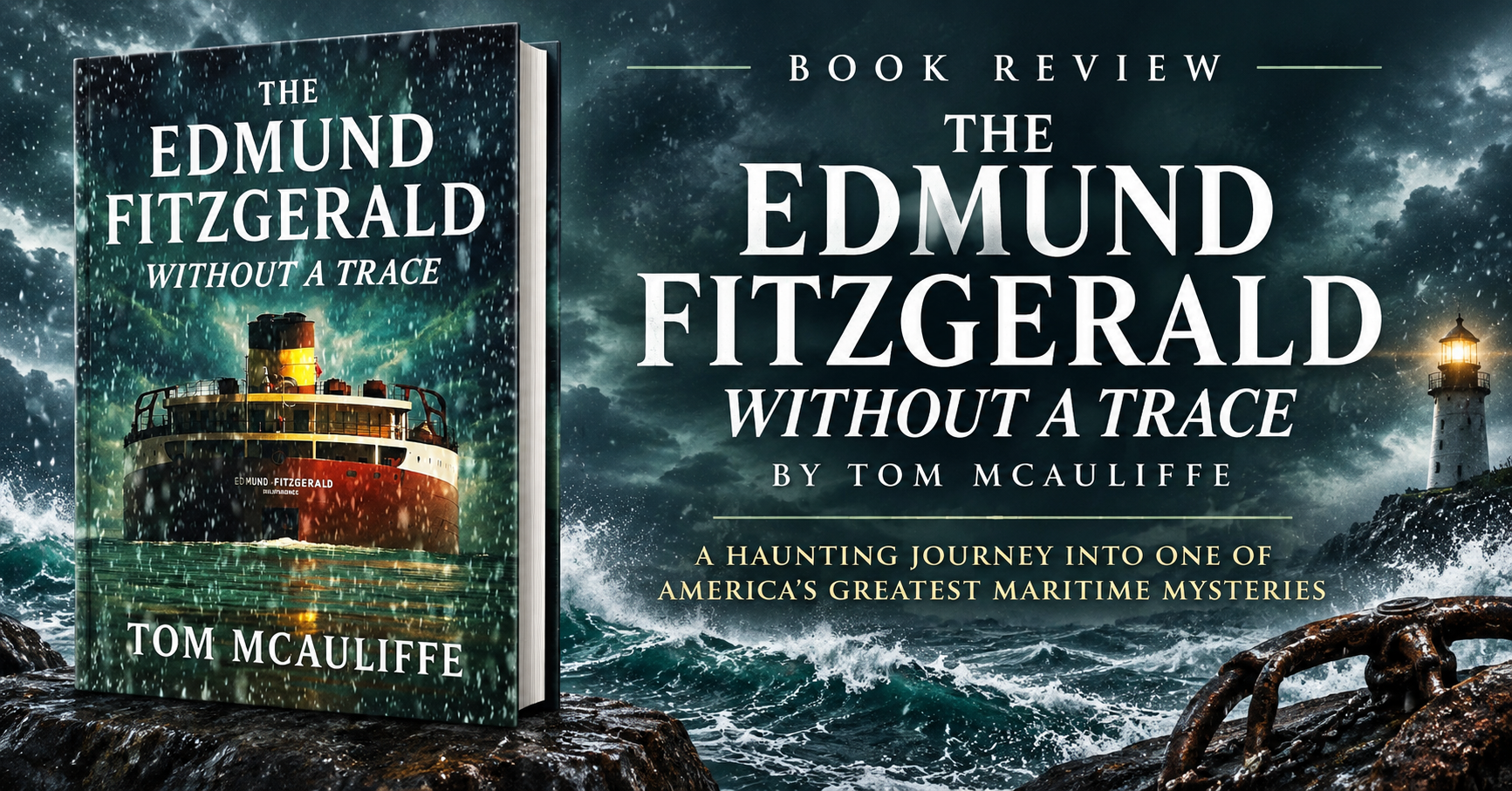
More than 50 years after the SS Edmund Fitzgerald sank in Lake Superior, the disaster remains one of the most haunting mysteries in Great Lakes history. What happened during the freighter’s final hours? Why did the ship sink so quickly? And what might the 29 men aboard have experienced as the storm closed in around them?
In The Edmund Fitzgerald: Without a Trace, author Tom McAuliffe revisits the legendary 1975 shipwreck through a compelling combination of historical research and dramatic storytelling.
Rather than simply recounting the facts surrounding the disaster, McAuliffe takes readers aboard the Fitzgerald and attempts to give a human voice to a tragedy that has fascinated historians, maritime enthusiasts, and ordinary readers for decades.
What Is The Edmund Fitzgerald: Without a Trace About?
On November 10, 1975, the SS Edmund Fitzgerald was traveling across Lake Superior carrying a load of taconite pellets when it encountered a powerful storm.
The 729-foot Great Lakes freighter was one of the most recognizable ships operating on the lakes.
But that evening, something went terribly wrong.
The Fitzgerald was communicating with the nearby SS Arthur M. Anderson as conditions deteriorated. Then the Fitzgerald disappeared.
There was no successful evacuation.
All 29 members of the Edmund Fitzgerald’s crew were lost.
The wreck was later discovered on the bottom of Lake Superior, but finding the ship did not completely solve the mystery surrounding its sinking.
Decades later, questions remain about exactly what caused the Edmund Fitzgerald to go down.
That mystery sits at the center of Tom McAuliffe’s book.
A Different Kind of Edmund Fitzgerald Book
There are already documentaries, historical accounts, investigations, articles, and books about the sinking of the Edmund Fitzgerald.
So what makes Without a Trace different?
McAuliffe isn’t simply interested in telling readers what happened to the Edmund Fitzgerald.
He wants readers to imagine what it might have felt like to be there.
The book blends documented historical events with fictionalized scenes and dialogue, filling some of the unavoidable gaps left behind when all 29 people aboard a ship are lost.
The Edmund Fitzgerald: Without a Trace isn’t simply a traditional nonfiction history of the shipwreck. Instead, McAuliffe uses historical storytelling to explore the human experience surrounding the disaster.
Bringing the 29 Men of the Edmund Fitzgerald Back Into the Story
One of the greatest strengths of The Edmund Fitzgerald: Without a Trace is its focus on the people aboard the ship.
Over time, famous disasters can become almost abstract.
We remember the date.
We remember the ship.
We remember the storm.
We remember that 29 men died.
But those 29 men weren’t simply part of a historical statistic.
They had families.
They had plans.
They had people waiting for them.
They boarded the Edmund Fitzgerald expecting another voyage across the Great Lakes.
McAuliffe’s storytelling repeatedly brings the reader back to that human reality.
Instead of viewing the Fitzgerald from a historical distance, we’re encouraged to imagine what it might have been like aboard the ship as Lake Superior became increasingly violent.
That perspective gives the tragedy an emotional weight that statistics and technical explanations alone cannot provide.
Tom McAuliffe’s Writing Style
There is something inherently cinematic about the final voyage of the Edmund Fitzgerald.
A massive freighter.
A November storm.
Dark water.
Enormous waves.
Radio communications between ships.
And then silence.
McAuliffe leans into that atmosphere.
The worsening weather creates a constant feeling of tension, while the confined environment aboard the ship can make portions of the story feel almost claustrophobic.
But the most interesting source of suspense is something every reader already knows.
The Edmund Fitzgerald is going to sink.
There is no mystery about the ultimate outcome.
That knowledge creates a different type of tension.
Every conversation and decision aboard the ship carries additional weight because we know where the voyage is heading.
Instead of wondering whether something will happen, we’re wondering:
When will it happen—and what will those final moments look like?
What Sank the Edmund Fitzgerald?
This question has fascinated people for decades.
Several theories have been proposed regarding the cause of the Edmund Fitzgerald sinking, including flooding through damaged or improperly secured hatch covers, structural failure, damage from shoaling, and the effects of enormous waves during the storm.
One thing I appreciated about Without a Trace is that the mystery isn’t reduced to an overly simple answer.
The book explores possibilities while acknowledging the uncertainty surrounding the disaster.
That’s important because the mystery itself is part of the Fitzgerald’s legacy.
The ship sank quickly.
There was no distress call that fully explained what was happening.
And there were no survivors who could tell investigators exactly what occurred during those final minutes.
The result is one of the most enduring unanswered questions in Great Lakes maritime history.
The Edmund Fitzgerald Is More Than a Famous Shipwreck
The story of the Fitzgerald didn’t end when the ship reached the bottom of Lake Superior.
There were families waiting for news.
There were search efforts.
There were investigations.
There were debates about what caused the disaster and whether it could have been prevented.
And eventually, there was remembrance.
The Edmund Fitzgerald disaster has become deeply connected to the history and culture of the Great Lakes.
People who weren’t alive when the ship sank still know its name.
They still visit museums and memorials.
They still read books about the disaster.
And every November, another generation discovers the story.
McAuliffe’s book fits into that tradition while approaching the tragedy with respect.
Is The Edmund Fitzgerald: Without a Trace Historically Accurate?
Without a Trace incorporates historical events and research, but McAuliffe also uses reconstructed scenes, imagined conversations, and narrative storytelling.
That means readers looking exclusively for a documentary-style investigation of the Edmund Fitzgerald may want to pair this book with traditional nonfiction sources about the disaster.
But readers who enjoy historical fiction inspired by true events will find McAuliffe’s approach touching and informative.
The imagined elements aren’t there simply to create drama.
They attempt to explore the part of the Fitzgerald story that history can never completely document:
The human experience aboard the ship.
At its heart, this is a story about people facing forces far beyond their control—and about the unanswered questions left behind when tragedy happens without witnesses.
Is The Edmund Fitzgerald: Without a Trace Worth Reading?
Yes—particularly if you’re fascinated by the Edmund Fitzgerald or enjoy historical storytelling that focuses on the human side of real events.
McAuliffe doesn’t attempt to transform one of America’s most famous maritime mysteries into a neatly solved case.
Instead, he asks readers to experience the story differently.
To step aboard.
To hear the storm.
To imagine the uncertainty.
And to remember that behind the legendary name Edmund Fitzgerald were 29 real people who never made it home.
The Edmund Fitzgerald: Without a Trace is a haunting and atmospheric exploration of one of the most famous shipwrecks in Great Lakes history.
Tom McAuliffe combines historical research with narrative reconstruction to take readers beyond the familiar facts surrounding the disaster and toward something more personal.
We may never know exactly what happened aboard the Fitzgerald during its final moments.
But stories like this remind us why people are still asking.
More than half a century after the ship disappeared beneath Lake Superior, the mystery continues to fascinate us.
And perhaps that’s because the story isn’t simply about a ship that sank.
It’s about 29 people whose final story disappeared with it.
The Edmund Fitzgerald: Without a Trace by Tom McAuliffe is a compelling and story driven exploration of the Edmund Fitzgerald disaster that reminds readers there were real lives behind one of America’s most enduring maritime legends.