
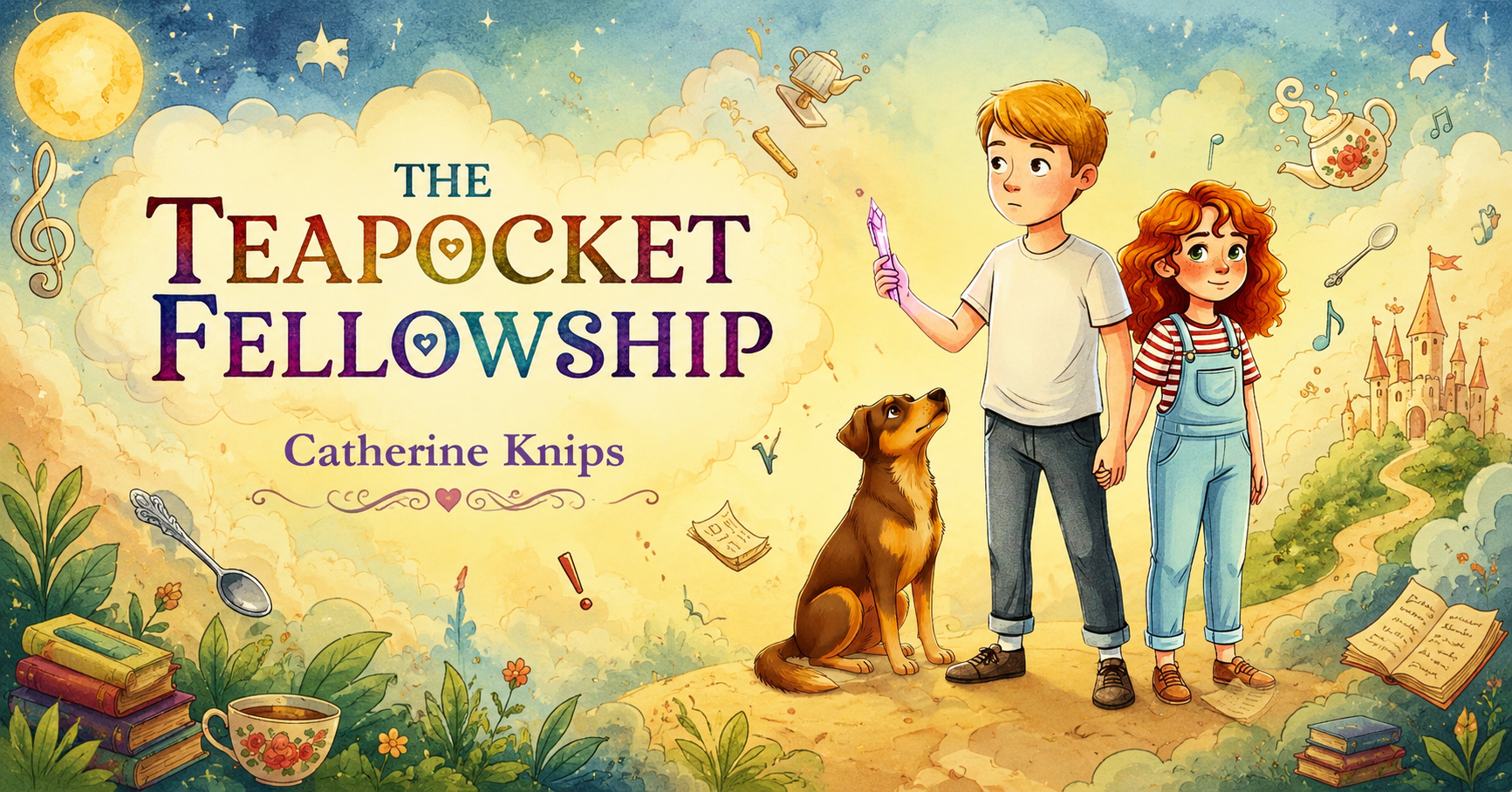
If you love the strange, whimsical world of Alice in Wonderland, The Teapocket Fellowship by Catherine Knips offers an imaginative opportunity to tumble back into Wonderland—only this time, a new generation is stepping into the story.
Filled with talking animals, magical pens, unusual companions, impossible rules, and a mysterious villain capable of changing the story itself, The Teapocket Fellowship combines the charm of classic Wonderland with an entirely new adventure.
In this spoiler-free review of The Teapocket Fellowship, we’re taking a closer look at the story, characters, writing style, and what makes this indie fantasy worth discovering.
What Is The Teapocket Fellowship About?
The Teapocket Fellowship introduces readers to Eliza and Hugo, two young characters who become caught up in an increasingly unpredictable Wonderland.
But this isn’t quite the Wonderland readers remember.
Something is changing the story.
A mysterious figure known as the Rogue Author has the ability to interfere with Wonderland itself. Rules can change, events can be rewritten, and the characters soon discover that their own stories may no longer be entirely under their control.
Eliza and Hugo find themselves surrounded by a wonderfully strange collection of companions as they attempt to understand what’s happening and what they can do to stop it.
And because this is Wonderland, the solution is unlikely to be simple—or sensible.
A Fresh Take on Alice in Wonderland
One of the strongest aspects of The Teapocket Fellowship is that Catherine Knips doesn’t simply retell Alice’s Adventures in Wonderland.
Instead, she asks:
What happens next?
The Wonderland we know becomes the foundation for something new.
Familiar elements are woven together with original characters, locations, magical objects, and conflicts. Alice and Cheshire still have roles to play, but this isn’t entirely their adventure anymore.
Eliza and Hugo represent a new generation entering Wonderland.
That distinction helps the story avoid feeling like a straightforward retelling. Instead, it feels like Wonderland has continued existing beyond the boundaries of the original story.
Meet Eliza, Hugo, Noodle and the Fellowship
The characters are a major part of the book’s charm.
Eliza brings curiosity and courage to the adventure, while Hugo often provides a more grounded perspective in a place where ordinary logic doesn’t get you very far.
And then there’s Noodle.
What begins with an adorable dog quickly becomes something considerably more Wonderland-like.
The larger fellowship introduces even more personality to the story, including characters such as Thistle and Dr. Steep, each contributing something different to the adventure.
These new characters are especially important because they give The Teapocket Fellowship its own identity.
Readers may come to the book because they recognize Wonderland, but the new characters give them reasons to stay.
The Rogue Author and the Power to Rewrite a Story
Perhaps the most interesting concept in The Teapocket Fellowship is its villain.
The Rogue Author doesn’t simply threaten the characters physically.
He threatens their stories.
He controls the ink.
He changes the rules.
And he wants Wonderland to become his story.
It’s a clever concept for a book set within a world already famous for bending the rules of reality.
It also introduces a deeper question beneath the whimsical adventure:
Who gets to decide how your story ends?
The magical pens and ink found throughout the book aren’t simply fun fantasy elements. They represent something larger—the ability to create, change, challenge, and ultimately participate in writing the story.
That makes the conflict with the Rogue Author particularly fitting.
The characters aren’t only fighting against a villain.
They’re fighting for the right to have a voice in their own story.
Catherine Knips’ Writing Style
Catherine Knips embraces many of the qualities readers associate with Wonderland: wordplay, eccentric conversations, strange logic, unexpected situations, and characters who don’t always behave according to the rules of the ordinary world.
But The Teapocket Fellowship doesn’t feel like an attempt to simply copy Lewis Carroll’s writing.
Knips uses those familiar Wonderland ingredients to create something distinctly her own.
The writing has a light, whimsical quality that works particularly well with the magical setting and unusual cast of characters.
There is plenty of adventure on the surface, but underneath it are themes involving creativity, courage, identity, friendship, and storytelling.
That combination allows the book to work on more than one level.
Younger readers can enjoy the magical adventure.
Older readers may find themselves thinking about some of the larger ideas hiding beneath all that Wonderland nonsense.
Themes in The Teapocket Fellowship
One of the themes I found most interesting is creative agency.
Stories are usually controlled by their authors.
Characters don’t get a vote.
But what happens when they do?
Throughout The Teapocket Fellowship, storytelling itself becomes part of the adventure. Pens, ink, authors, characters, and narratives aren’t simply outside mechanisms used to create the book—they become pieces of the world itself.
The story also explores friendship and courage, particularly the kind of courage required when you don’t completely understand the rules.
And in Wonderland, understanding the rules isn’t always an option.
Sometimes you simply have to decide what you believe is right and keep going.
Who Should Read The Teapocket Fellowship?
I would recommend The Teapocket Fellowship to readers who enjoy whimsical fantasy, Wonderland-inspired stories, talking animals, magical objects, quirky characters, imaginative adventures, and books that play with the idea of storytelling itself.
It’s especially worth checking out if you enjoy discovering indie books that approach familiar fictional worlds from an unexpected direction.
Fans of Alice in Wonderland will recognize the spirit of the world, but you don’t need to be a Wonderland expert to follow Eliza and Hugo’s adventure.
Is The Teapocket Fellowship Worth Reading?
For readers who enjoy whimsical, character-driven fantasy, yes.
The Teapocket Fellowship takes the familiar idea of Wonderland and gives readers something new to discover within it.
Rather than relying entirely on nostalgia, Catherine Knips introduces a new cast, a new threat, and a fascinating central idea: What if the characters could fight back against the person trying to control their story?
That’s where the book becomes particularly memorable.
Because underneath the magical pens, talking animals, impossible places, and Wonderland absurdity is an idea almost every reader can understand:
Our stories aren’t always going to unfold the way we expect.
Sometimes the rules change.
Sometimes someone else tries to decide who we’re supposed to be.
And sometimes…
the characters write back.
The Hidden Book Nook Recommendation
If you’re searching for a whimsical indie fantasy filled with Wonderland-inspired magic, eccentric characters, friendship, adventure, and a creative twist on the power of storytelling, The Teapocket Fellowship by Catherine Knips deserves a place on your reading list.
Book: The Teapocket Fellowship
Author: Catherine Knips
Genre: Fantasy / Wonderland-Inspired Fiction
Perfect for readers who enjoy: Whimsical fantasy, Alice in Wonderland, talking animals, magical adventures, unusual characters, and stories about the power of storytelling.
The Hidden Book Nook celebrates indie and self-published books through thoughtful reviews, recommendations, author spotlights, and bookish content designed to help readers discover their next favorite story.